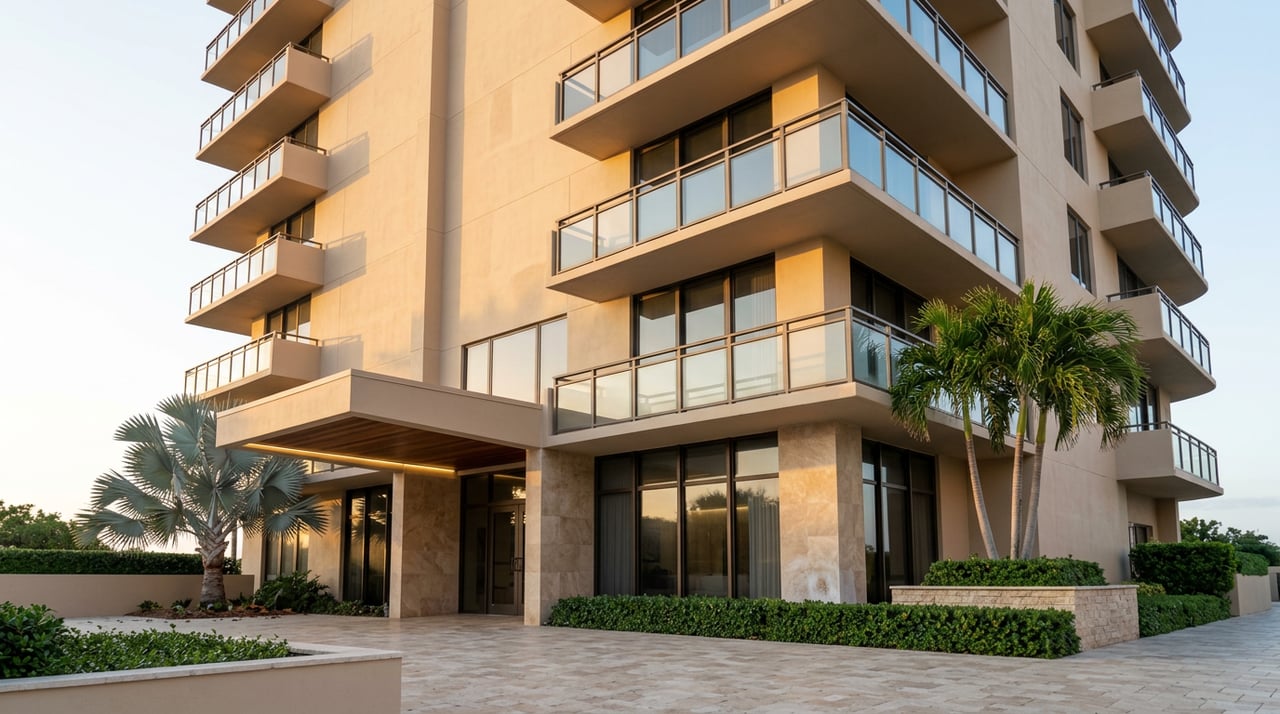
Buying a Boca Raton Condo in 2026? Check the Building's Age Before the View
September 10, 2026
September 10, 2026
What's the one number on a Boca Raton condo listing that tells you more about your first year of ownership than the square footage, the floor, or even the price per foot? It's not the HOA fee. It's the year the building got its certificate of occupancy.
That single date now determines whether a condo association in Boca Raton is legally required to have completed a structural inspection, whether its reserve fund is fully funded or scrambling to catch up, and whether the next twelve months bring a routine budget or a five-figure bill in the mail. Buyers who treat an older oceanfront unit as a bargain because the price per square foot looks soft are often missing the actual cost of ownership, and it isn't in the listing description.
Here's the pattern that catches people off guard. A buyer falls for a unit in an older building near A1A, writes an offer, and gets it accepted. Somewhere in the following days, the condo documents land in an inbox: the declaration, the budget, the association's most recent financial statement, and if the building is three habitable stories or taller, a Structural Integrity Reserve Study, or a statement that one hasn't been completed. Florida law requires all of this to be disclosed to a resale buyer, but the timing means most people are reading it after they've already fallen in love with the layout and the light.
The document that matters most in that packet is the SIRS. It's a study of eight specific structural components: roof, load-bearing structure, fire protection, plumbing, electrical, waterproofing, and windows and doors, plus any other item that affects those systems and costs enough to count. What the SIRS tells you is whether the association has actually saved the money it needs, or whether it's been kicking that can down the road the way many buildings did for decades.
Florida's milestone inspection law sets a standard trigger of 30 years for condo and cooperative buildings three stories or taller. But local building officials can move that trigger earlier for buildings near salt water, and in Boca Raton, that's exactly what happened. Most of the city, including essentially everything east of I-95, falls inside the three-mile coastal zone that requires the first inspection at 25 years instead of 30.
That five-year difference matters more than it sounds like. It means a building that opened its doors in 2001 is already inside the compliance window this year, not five years from now. Buyers scanning listings for "1998 construction" or "2000 built" in East Boca should read those years the way they'd read a car's odometer. The clock has already started, whether or not the association has acted on it yet.
Coastal buildings carry an additional physical reason for the earlier trigger. Salt-laden air accelerates corrosion of the steel reinforcing bar inside concrete, which is the leading cause of structural deterioration in South Florida's older towers. Buildings along the Intracoastal and near the Boca Raton Inlet face that exposure directly, which is part of why local building officials didn't wait for the standard 30-year mark to require a look.
| Building era | Milestone status in Boca Raton | What a buyer should expect |
|---|---|---|
| Pre-1995 | Already past the 25-year coastal trigger | Milestone inspection and SIRS should already be on file. Ask for both, plus any Phase 2 follow-up. |
| 1996 to 2001 | Inside or entering the compliance window now | Confirm whether the inspection has been scheduled or completed. Ask about funding for any findings. |
| Post-2001 | Fewer near-term structural triggers | SIRS is still required regardless of age once a building hits three habitable stories, so ask anyway. |
For years, Florida condo associations could vote to waive or underfund their reserves, which kept monthly dues artificially low. Plenty of Boca Raton buildings did exactly that. As of January 1, 2026, that option is gone for the structural components covered by a SIRS. Associations can no longer vote to skip or reduce that funding, which means buildings that spent decades deferring now have to catch up on a state-mandated timeline, not their own.
This is the part of the story that makes assessments feel sudden even though the underlying deterioration wasn't sudden at all. The roof didn't fail overnight. The plumbing didn't corrode in a single budget cycle. What changed is that the legal option to keep pretending the reserve fund was fine disappeared on a specific date, and boards that had been underfunding for years are now required to close that gap through some combination of higher monthly dues, loans, lines of credit, or special assessments. House Bill 913, the 2025 legislation that set these current rules, also gave boards more flexibility in how they raise that money, but flexibility in financing doesn't make the bill smaller. It just changes who ends up writing the check and when.
The dollar figures involved aren't abstract. The Boca Raton Tribune reported that the inflation-adjusted reserve threshold for 2026 sits at $25,675, up from the original $10,000 threshold, meaning smaller-ticket items are increasingly swept into the mandatory funding requirement too. Statewide, one-time special assessments in the range of $10,000 to $100,000 or more per unit have become common in older and coastal buildings, and monthly dues in some of those same buildings have climbed 20 to 40 percent. Add a hardening insurance market on top, with flood coverage under FEMA's Risk Rating 2.0 continuing to rise 15 to 18 percent a year as of early 2026, and it's easy to see why a unit's true carrying cost can look nothing like its listed HOA fee.
A buyer's agent who knows this market pulls documents before the offer goes in, not after. For any Boca Raton condo three habitable stories or taller, that list should include:
If the building has 25 or more units, a newer rule now works in the buyer's favor here. Starting January 1, 2026, those associations are required to post governing documents, budgets, and reserve studies to a website or app, which means a buyer no longer has to take a board's word for it that everything is in order. The paperwork should already be sitting somewhere reviewable, and if it isn't, that gap is worth asking about directly.
One quieter change from the same 2025 legislation matters for anyone reviewing these documents under time pressure. The cancellation window for a resale condo buyer used to run three business days from receipt of the association documents. Under the current rules, that window is seven business days for contracts signed on or after July 1, 2025. It's not a lot of extra time, but for a buyer relocating from out of state and reading a SIRS for the first time, four additional business days can be the difference between rushing a decision and actually having an engineer or attorney look at what the report says.
That review matters because a SIRS on file doesn't automatically mean the funding question is settled. The study needs to line up with the current budget and recent board minutes. If a major item shows up in one document but not the other, that's worth a direct question to the board before the cancellation window closes, not after.
Two condos can list at the same price and carry very different exposure once you factor in age and location. A 1980s tower directly on A1A near the inlet is likely already past its 25-year trigger and facing the corrosion risk that comes with direct salt exposure. A unit in the Mizner Park area built after 2000 may be newer construction with the SIRS requirement still tied purely to its habitable-story count rather than an imminent age deadline. Inland and gated communities often carry a different profile entirely, generally lower flood exposure and sometimes lower carrying costs, but the same SIRS rules still apply once a building crosses three habitable stories.
None of this means older or coastal is automatically a bad buy. Some of Boca's most desirable buildings have well-funded reserves and clean inspection histories precisely because their boards didn't wait for the law to force the issue. The point is that age and coastline proximity are now data points a buyer can actually use, the same way you'd read a home inspection report, rather than a vague worry to set aside until closing.
What's the real difference between a milestone inspection and a SIRS? A milestone inspection is a one-time structural check that happens at 25 or 30 years and then every 10 years after. A SIRS is the ongoing financial plan that prices out how much the association needs to save for those same structural components. A building can pass its milestone inspection and still have an underfunded SIRS.
Does a low monthly HOA fee mean the building is well managed? Not necessarily, and in 2026 it may mean the opposite. A fee that's stayed flat for years in an older coastal building is worth a closer look at the reserve study, not a reason for comfort on its own.
Can I still walk away after signing if the documents raise red flags? Florida's extended review window gives a resale buyer seven business days from receipt of the association's disclosure documents to cancel the contract, so that document review is not just informational. It's a real decision point.
If you're weighing a condo purchase in Boca Raton and want someone who reads these documents the way a local should, not just a checklist, Karen Diaz offers a complimentary consultation to walk through a specific building's paperwork before you write an offer. Bilingual service in English and Spanish is available for relocating buyers who want that review done in whichever language makes the fine print easiest to trust.

Karen Lee Diaz
Karen Lee Diaz is a real estate agent with Compass, serving Boca Raton and the surrounding South Florida luxury market. With a background in social work and a doctorate, Karen approaches real estate as more than transactions—she's built her career on relationships, listening closely to clients' needs and guiding them through one of life's biggest transitions, whether they're first-time homebuyers or high-net-worth investors. Bilingual in English and Spanish, she brings a rare combination of warmth, advocacy, and deep local knowledge to every deal, measuring her success not in closings but in the lasting impact she makes in her clients' lives.



Get assistance in determining current property value, crafting a competitive offer, writing and negotiating a contract, and much more. Contact Karen today.